

History
A licensed tennis game with one licensed player.
The game
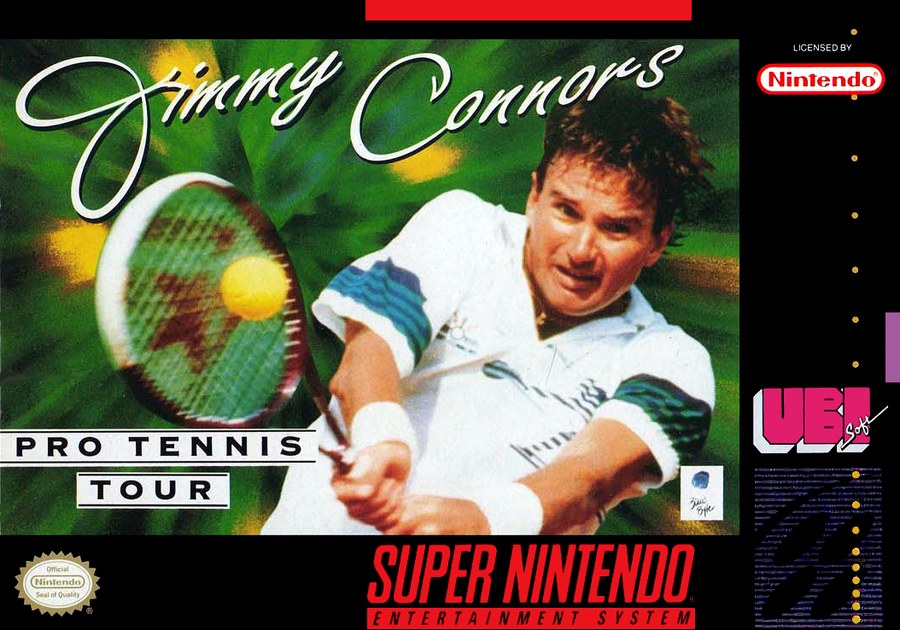
| Developer | Blue Byte Software |
| Publisher | Ubi Soft; Misawa Entertainment in Japan |
| Released | North America, December 1992; Japan, 29 October 1993; PAL, 27 October 1994 |
| Platform | Super Nintendo Entertainment System |
| Genre | Sports |
| Players | 1 to 2, simultaneously; singles and doubles against one to three computer opponents |
| Cartridge | 4 Mb, LoROM, 200 ns |
| Saving | Passwords - the cartridge has no save memory |
| Product codes | SNS-JC (USA), SHVC-JC (Japan) |
You play as Connors, working through a season of tournaments in pursuit of the world number one ranking. The tour lists twenty-nine stops across twenty-eight cities - Paris hosts two - running from Wimbledon and Monte Carlo to Melbourne, Bombay, Nairobi and Acapulco. Courts come in grass, hard, clay, indoor and desert, plus an Antarctic one that is exactly the joke it sounds like. Matches are played to one set, best of three or best of five.
Between matches the game offers five coaches. Three are graded by standard - beginner, advanced and professional - and two are specialists, one for net play and one for service.
The cartridge holds no save memory at all. Progress through a tour is carried by password instead, entered from a fixed alphabet of consonants on the continue screen - an economical choice that was common on cartridges of the period, where battery-backed memory added real cost to every unit sold.
Blue Byte and the Pro Tennis Tour series
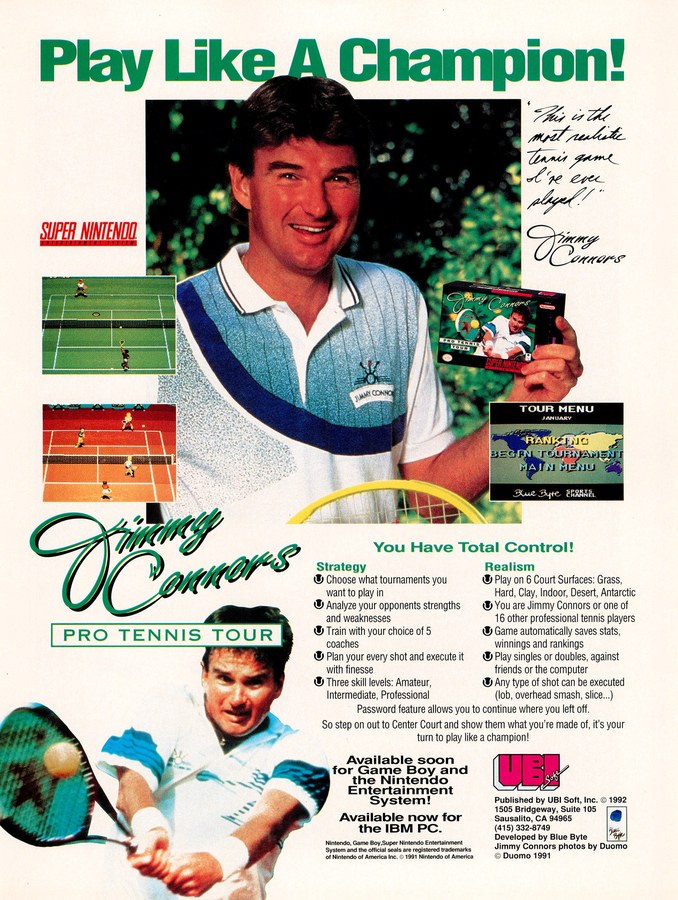
This is not a one-off licensed tie-in. It is the third game in Blue Byte's own Pro Tennis Tour series, following Pro Tennis Tour in 1989 and Pro Tennis Tour 2 in 1991. The studio's name is still in the cartridge: the string BLUE BYTE sits in the ROM alongside the title text.
By the third entry the series had a licence attached, and the publishing was split by region - Ubi Soft handled North America and Europe, Misawa Entertainment the Japanese release. The regional versions are genuinely separate builds rather than one cartridge with a different label: USA, Japanese, German, French and PAL European releases all carry distinct ROMs. A near-final prototype of the German version also survives, built for NTSC rather than PAL.
One name on the box, fifteen invented ones inside
The licence covered Connors and nobody else. That was the ordinary situation for sports games of the period: a player's likeness costs money, and sixteen of them cost sixteen times as much. So the tour Connors plays is populated by invented opponents - MUELLER, WURZL, BAECKER, KRAUSE, PAPOU, WIJNFORT.
What makes this game unusual is how thinly the disguise was applied. The developers did not invent players; they renamed real ones and left everything else in place. Each slot keeps:
- the real player's nationality - the flag beside the name;
- a recognisable portrait, drawn from photographs of the actual player;
- a rating and playing style matching their real standing and game.
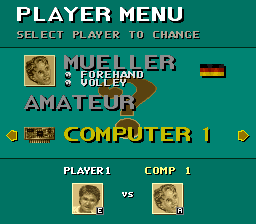
The result is a roster that identifies itself. A German serve-and-volley player with a rating near the top of the field and a portrait of a red-haired man is not a mystery. Neither is the Swede whose portrait is unmistakably Stefan Edberg. The players behind the invented names are those of the years the game was made, between 1990 and 1992 - the names are the only part that was ever fictional.
The field is exactly sixteen deep. The game stores no other player names, and the tournament ladder runs first round, quarter final, semi final, final - a sixteen-entrant draw, so every opponent on tour is one of the sixteen.
Jimmy Connors
The pitch on the packaging is Connors himself: "the greatest tennis champion ever", with 159 weeks at number one and eight Grand Slam titles to his name. The claim was a marketing line rather than a neutral assessment, but the career behind it was real enough that the game leans on it entirely - his is the only name the box could legally print, and the only one it needed.
By the time the cartridge reached shops Connors was in his very late thirties and near the end of a career that had begun in the early 1970s, which places the game at the tail of his run rather than at its peak. That timing is part of why the licence was available at all.
Reception
Nintendo Power reviewed the game in issue 44, January 1993, and was politely unenthusiastic. Its four category scores, each out of five:
| Graphics and Sound | 3.4 |
| Play Control | 2.9 |
| Challenge | 3.0 |
| Theme and Fun | 3.1 |
Play control drew the weakest mark, which is consistent with a game that offers two separate control schemes - an easy mode and a full-control mode where aim and shot weight are the player's responsibility. The review's January 1993 cover date also helps pin the North American release to the end of 1992, ahead of both the Japanese and PAL versions.
Other versions, and one that never arrived
An 8-bit game called Jimmy Connors Tennis was developed separately by NMS Software and released in 1993. It shares the licence and the name rather than the code, and should not be mistaken for a port of this cartridge.
A version for the Atari Jaguar was announced in November 1993 and never released. No reason was ever given publicly, and the Jaguar's own commercial trouble makes a quiet cancellation the unremarkable explanation.
Sources
- Jimmy Connors Pro Tennis Tour - series position, regional release dates, the 8-bit game and the cancelled Jaguar port.
- superfamicom.org - cartridge size and speed, mapping, absence of save memory, product codes, regional builds.
- SNES Central - publishers by region, player count, password saving, the Nintendo Power scores and the German prototype.
- LaunchBox Games Database - box front and promotional flyer scans, and in-game screenshots.